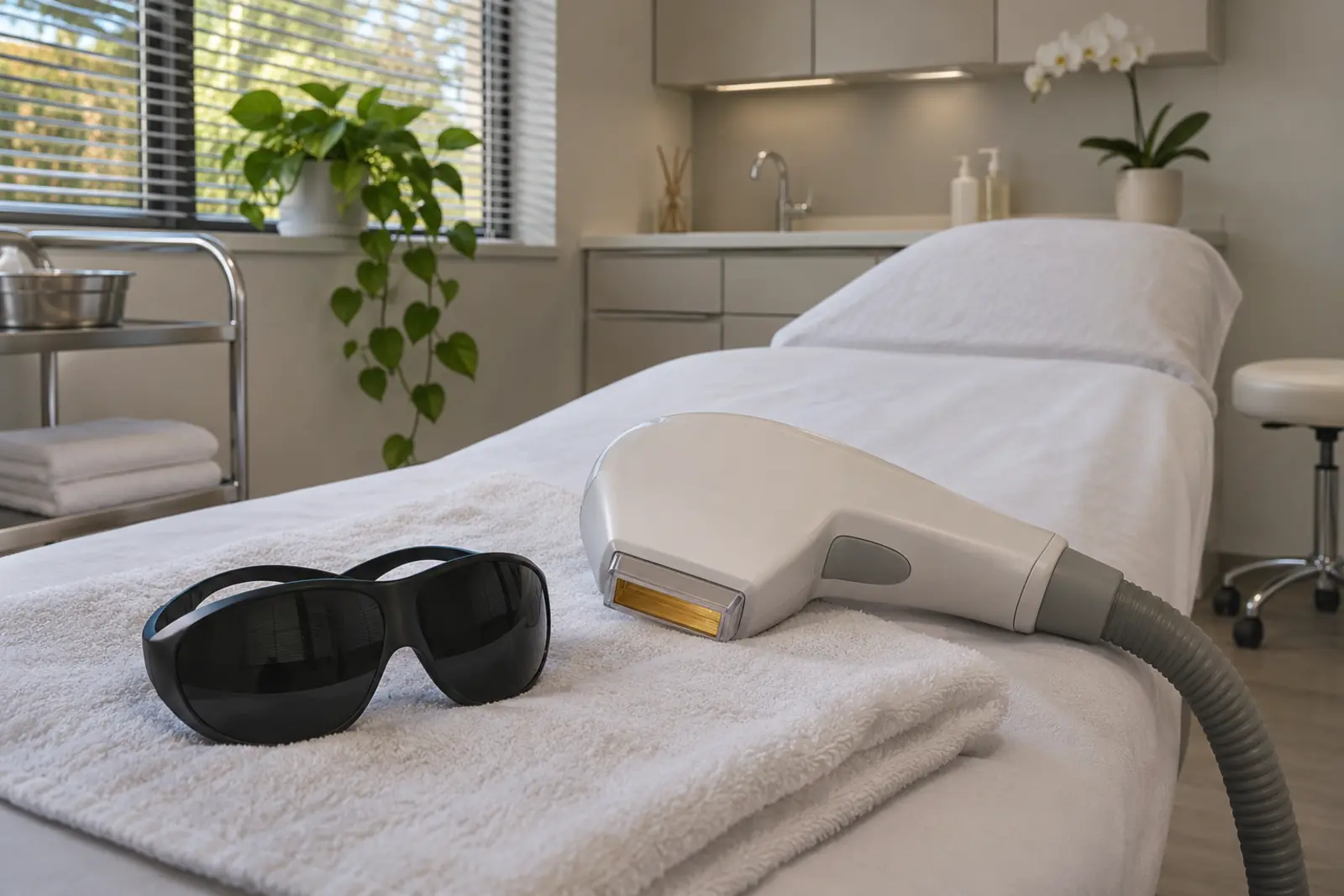
Optimised pulsed light systems target pigment and vessels rather than resurfacing the skin. Dual wavelength absorption targets haemoglobin and melanin, which is what allows brown spots, sun damage, rosacea and visible vessels to be cleared with minimal discomfort. Built-in handpiece cooling does most of the work of keeping the treatment tolerable.
How pulsed light works
Intense pulsed light (IPL) is not a laser. A laser delivers one wavelength; an IPL device uses a xenon flashlamp to emit broadband, non-coherent light, usually in the 500 to 1200 nm range. Because haemoglobin, water and melanin absorb light across broad bands, the light does not have to be a single colour to be selective.
Cutoff filters, ranging from 515 to 755 nm, block the shorter wavelengths so the operator can tailor the output to the target, and pulse duration and the delay between pulses can also be adjusted. Cooling, whether by contact cooling, cryogen spray or refrigerated air, protects the surface of the skin while the pigment or vessel beneath absorbs the energy. Unlike pulsed dye laser, IPL typically avoids the bruising known as purpura.
Measuring rather than guessing
Melanin-reading technology removes some of the subjectivity from skin type assessment. Several measurements are taken near the treatment area and used to set treatment parameters, which can then be refined with a test spot before a full pass.
This matters because light-based treatment on incorrectly assessed skin is the classic route to unwanted pigment change. Darker skin carries a higher risk of residual discolouration and hyperpigmentation, and one published review recommends the 755 nm filter with longer delays between pulses in that situation.
Where it fits
Photofacial treatment suits patients with sun damage who cannot give up a week to laser resurfacing. Visible results can appear after a single treatment, generally with no social down time.
The two approaches are complementary rather than competing: light-based treatment clears red vessels and pigmented areas, while CO2 resurfacing addresses wrinkles, tightening and texture. Combining them is common where both problems are present.
What it treats and how often
Published reviews list telangiectasias, redness from rosacea and poikiloderma of Civatte among the vascular targets, and sun-induced brown spots (solar lentigines) and freckles among the pigmented ones. Pigmented treatments are usually repeated every 3 to 4 weeks. One academic medical centre describes a typical course as five to six sessions two to four weeks apart, with maintenance once or twice a year. Sessions generally last 15 to 30 minutes depending on the area.
After the session
Redness and slight swelling usually settle within a few hours, and treated brown spots may darken at first before flaking away over the following days. Mild stinging during treatment is common; blistering or scarring is rare.
Sun avoidance before and after treatment matters. The same medical centre advises against treating skin with a recent tan, and recommends sunscreen of at least SPF 30 during recovery and afterwards to prolong results. Active skin infections, pregnancy and certain medications such as isotretinoin are listed as reasons to avoid treatment, and darker skin tones (Fitzpatrick IV to VI) or melasma may make a patient a less suitable candidate.
For related reading, see the guide to chemical peels around the eyes and the page on dark circles under the eyes. Sources used: UT Southwestern Medical Center and Goldberg, J Clin Aesthet Dermatol 2012.
General information only, not medical advice. Individual anatomy and healing vary. See the disclaimer.