A meaningful share of eyeliner users has a permanent tattoo version - though no large-scale prevalence survey has established a precise figure, demand for the procedure has grown steadily and oculoplastic surgeons encounter it with increasing frequency. The demographic most likely to seek blepharoplasty, women aged 50 to 70, overlaps directly with the demographic most likely to have had permanent eyeliner placed 10 to 20 years ago. That overlap is clinically significant, and yet most pre-surgical information available to patients treats the two subjects as unrelated. They are not. Existing permanent eyeliner changes how a blepharoplasty is planned, where incisions go, how tissue heals, and what the final cosmetic result looks like. It also introduces dry-eye risk, hidden inflammatory findings, and imaging disclosure requirements that must be addressed before the surgery date - not discovered afterward.
What Blepharopigmentation Actually Is
Blepharopigmentation is the technical term for cosmetic tattooing of the eyelid margin - what most patients call permanent eyeliner. Unlike surface cosmetics, it deposits pigment beneath the skin using a tattoo needle, and the anatomy of the eyelid makes that needle placement unusually consequential.
Where the Needle Goes
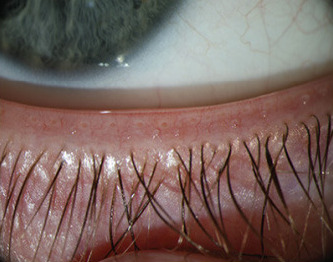
The standard technique deposits pigment at the mucocutaneous junction of the eyelid - the narrow transition zone where outer skin meets the inner wet conjunctival surface. That junction sits within 1 to 2 mm of the meibomian gland orifices, the small openings through which the glands secrete the lipid layer of the tear film. Upper-lid permanent eyeliner follows the lash line just above these orifices. Lower-lid eyeliner follows the sub-lash margin below them. The needle is not working near critical ocular structures by coincidence - it is working at them.
Pigment types used in permanent eyeliner fall into two main categories:
- Iron oxide pigments - used in most black and brown formulations, long-lasting but magnetic, capable of producing MRI signal artifacts and a warming sensation during orbital scanning
- Organic carbon-based pigments - less common, fade more predictably, do not carry iron oxide's magnetic properties
- Mixed formulations - commercial inks often combine both types, and patients frequently cannot identify which was implanted in their own procedure without records from the tattooing provider
Procedures performed 10 to 20 years ago used denser, deeper iron oxide deposits than modern protocols. The 50-to-70-year-old blepharoplasty candidate who had permanent eyeliner placed at the height of its popularity is likely carrying more pigment, implanted more deeply, in tissue a surgeon is now assessing for excision or dissection.
The Dry-Eye Risk That Exists Before Surgery Begins
What the Controlled Study Data Shows
A published study enrolled 40 women - 10 with tattooed eyeliner and 30 without - and compared the two groups across standard measures of ocular surface health. The findings were clear: the tattooed group had significantly shorter tear break-up time, lower tear secretion volume, greater fluorescein corneal erosion staining, and measurable meibomian gland dropout compared to controls. The mechanism ties directly to anatomy: needle passes through or immediately adjacent to meibomian gland orifices disrupt gland architecture and reduce the lipid output those glands provide.
- Tear break-up time: shorter in tattooed patients, indicating a lipid layer too thin to protect the corneal surface between blinks
- Schirmer tear secretion: reduced, confirming the aqueous component of the tear film is also affected
- Corneal staining: greater erosion in tattooed patients, the downstream result of an unstable tear film over time
- Meibomian gland assessment: documented gland dropout visible on infrared meibography in tattooed lids
This matters for blepharoplasty because eyelid surgery is itself a recognized contributor to dry-eye symptoms. Upper lid surgery can reduce blink mechanics. Lower lid surgery can alter lower-margin position and affect lacrimal drainage. When a patient's ocular surface is already compromised from tattooing, these surgical insults add to existing dysfunction rather than standing alone. A patient asymptomatic before surgery can become genuinely symptomatic afterward. Oculoplastic surgeons screen permanent eyeliner patients for ocular surface disease before scheduling blepharoplasty because treating pre-existing disease before surgery - not after - produces better outcomes. If meibomian gland dysfunction is significant on screening, management with warm compresses, lid hygiene, or prescription drops may be warranted in the weeks before the surgical date.
Upper Eyelid Blepharoplasty and Permanent Eyeliner
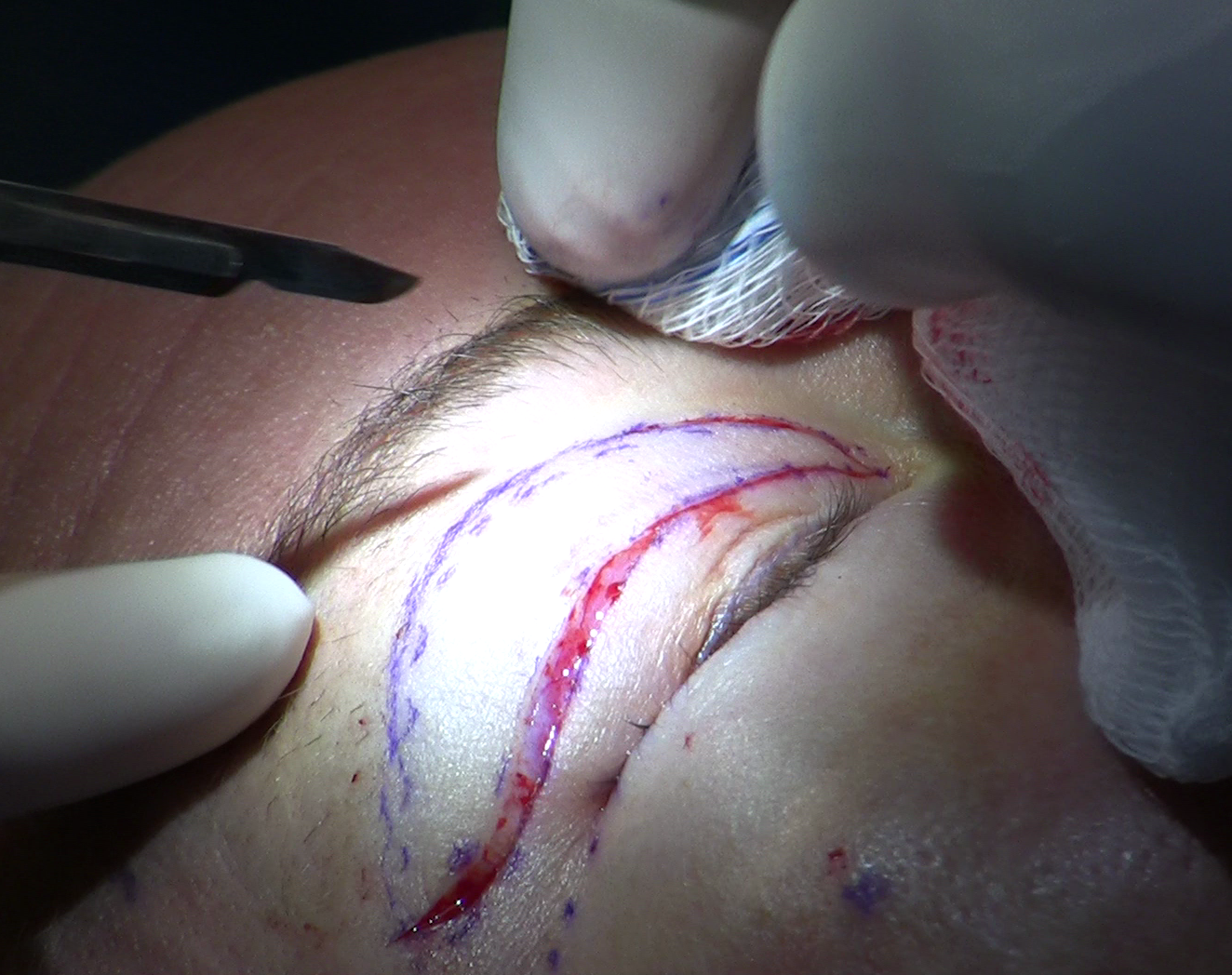
Upper blepharoplasty excises a crescent of excess skin from the upper eyelid. The surgeon marks a lower incision line in or just below the natural crease and an upper incision line corresponding to how much skin will be removed. Permanent upper-lid eyeliner is typically deposited at or just above the lash line - below the crease - placing it within the skin commonly targeted for excision.
What Happens to the Tattoo Line After Excision
When excised skin contains the tattooed segment, that portion of the liner is removed with the specimen. The residual lower margin of the tattoo - the portion on non-excised skin - will sit at a different height relative to the new lash line position. The result can be a tattoo line that appears displaced upward, interrupted at the medial or lateral edges, or asymmetric between the two lids, particularly when the amount of skin removed differed between eyes, as is common.
Pigment migration compounds this. When deeply implanted pigment is in tissue subjected to dissection or postoperative edema, it can track along tissue planes. Pigment originally placed too far into subcutaneous fat rather than the dermis is especially prone to this. Patients occasionally report their permanent eyeliner appears smudged or expanded in the weeks after upper blepharoplasty as residual edema drives pigment movement in remaining tissue. This stabilizes as swelling resolves, but it underscores why surgeons must map the planned excision relative to the existing tattoo and show patients - with photographs marked with incision lines - exactly what to expect before surgery, not after it.
Lower Eyelid Blepharoplasty and Permanent Eyeliner
Why the Subciliary Incision Is a Direct Problem
The subciliary approach places the skin incision 1 mm below the lower lash line. Lower-lid permanent eyeliner is deposited at exactly that sub-lash margin. The incision does not pass near the tattoo - it passes directly through it. Cutting through tattooed dermis introduces complications absent from untattooed skin: pigment disperses into wound margins, the altered collagen structure of tattooed dermis affects how wound edges appose and scar, and postoperative edema can drive pigment into adjacent tissue planes, producing a smeared or expanded line.
When the Transconjunctival Route Is the Smarter Choice
The transconjunctival approach makes no skin incision. The surgeon accesses lower eyelid fat compartments through the inner conjunctival surface, leaving the entire external eyelid surface intact. For patients with lower-lid permanent eyeliner, this preserves the tattoo line completely and avoids the wound-healing complications of cutting through pigmented dermis. It is not appropriate for every patient - it does not directly address excess lower lid skin - but when the anatomy supports it, surgeons often choose this route specifically to sidestep the tattooed-skin problem.
| Feature | Subciliary approach | Transconjunctival approach |
|---|---|---|
| Skin incision location | 1 mm below lash line, through tattoo zone | None - internal conjunctival only |
| Effect on lower lid tattoo | Cuts through pigmented dermis; dispersion risk | Tattoo line left fully intact |
| Wound healing in tattooed skin | Altered collagen may affect scar quality | Not applicable |
| Addresses excess lower lid skin | Yes, directly | Not primarily |
| Preferred when lower lid tattoo present | Only when skin removal is essential | Often favored to avoid tattoo disruption |
Hidden Tissue Changes: Fibrosis, Inflammation, and Granulomas
A 2021 prospective case-controlled study published in the Journal of Cosmetic Dermatology found that upper eyelid soft tissue was measurably thicker in patients with ipsilateral eyebrow tattooing compared to controls, and dermal fibrosis was statistically more frequent in the tattooed group. The mechanism reflects what foreign pigment does in tissue over years: inflammatory cells encapsulate pigment particles, fibroblasts respond by laying down collagen, and the dermis becomes denser and less pliable. For the operating surgeon, thickened lid tissue changes dissection dynamics and can require adjusted technique even before the visible anatomy suggests it.
Published case reviews of eyelid tattooing complications consistently identify granulomatous reactions as a leading adverse event, with some series reporting them in more than half of cases, though rates vary considerably by study design and pigment type. These do not always announce themselves visibly before surgery. Papillary conjunctivitis has also been documented as a delayed reaction appearing months after permanent tattooing, indicating the kind of chronic, low-grade ocular surface inflammation that can compound the chemosis and swelling typical in blepharoplasty recovery.
The most severe documented complications include full-thickness eyelid penetration with permanent pigmentation of the cornea, conjunctiva, or limbus. This is rare, but it means the pre-blepharoplasty consultation should include ophthalmologic slit-lamp examination to identify any existing corneal or conjunctival pigment deposits before surgical planning is finalized.

MRI Imaging, Iron Oxide, and What to Tell Your Radiologist
Iron oxide pigments in black and brown permanent eyeliner produce MRI signal artifacts in the peri-orbital region. For pre-blepharoplasty workup involving orbital imaging - for orbital mass evaluation, thyroid eye disease staging, or structural review - these artifacts can reduce diagnostic value. Radiologists informed in advance can apply protocols to minimize artifact and interpret images with that limitation in view.
A 2023 Danish study confirmed that magnetite, goethite, and hematite are the specific magnetic fractions present in permanent makeup inks. That finding clarifies why the warming sensation patients report during orbital MRI occurs: the mechanism is magnetic force acting on those iron-containing particles rather than a true thermal burn in most cases. At least one documented case recorded visible eyelid erythema after brief MRI exposure attributable to this interaction. MRI is not contraindicated with permanent eyeliner, but disclosure is not optional.
Laser Removal of Permanent Eyeliner Before Blepharoplasty
Patients who choose to remove permanent eyeliner before surgery face a different risk profile than patients removing tattoos elsewhere on the body. The cornea and conjunctiva sit millimeters from the treatment area, and standard protective eyewear - a patch placed over closed lids - is inadequate for periocular work. Eyelid laser tattoo removal requires stainless-steel corneal eye shields placed directly on the globe under topical anesthesia to protect the anterior eye from laser scatter. Without them, corneal injury is a genuine risk. Before proceeding, patients should ask specifically whether the treating provider has periocular laser removal experience and whether intra-ocular shields are standard in their protocol.
A clinical chart review of eyeliner laser removal cases found no documented scarring, permanent lash loss, necrosis, or burns when correct protocols were followed - an encouraging record that depends entirely on proper technique and patient selection. Multiple treatment sessions spaced weeks apart are typically required. Patients planning removal before blepharoplasty need to allow time for the full course of treatment and for treated tissue to stabilize before surgery. The two timelines - laser removal and surgical scheduling - need to be coordinated with both providers before removal begins, not after the last session.
The Sequencing Question: Surgery First or Eyeliner First
Blepharoplasty first, permanent eyeliner second. Post-surgical edema alters eyelid anatomy for months, and permanent eyeliner placed before that edema fully resolves will be positioned relative to anatomy that has not yet reached its final state - a placement that cannot be corrected without laser removal.
The recommended order is blepharoplasty first, permanent eyeliner second. Post-surgical swelling takes time to fully resolve - typically three to six months before lid position, skin tension, and crease height have stabilized. Permanent eyeliner placed during that window is placed relative to temporarily distorted anatomy. When the edema resolves, the liner sits at the wrong height permanently.
For patients who already have permanent eyeliner and want blepharoplasty, the reverse timing concern is acute inflammation. Most surgeons ask that tattooing have been completed at least three months before surgery. That interval allows the tattoo-related acute inflammatory response to subside before surgical wound healing begins. Operating through recently tattooed tissue - within weeks of a new or touched-up procedure - compounds inflammatory burdens in ways that impair wound closure and increase the risk of poor healing. The timing requirement applies to touch-ups and color corrections, not just the original placement.
Planning the Consultation
What to Disclose
Patients with permanent eyeliner should come to the pre-blepharoplasty consultation with specific information the surgeon cannot otherwise obtain:
- When permanent eyeliner was placed, including all touch-up, correction, or color-change sessions and approximate dates for each
- The treating location and any available records identifying the pigment brand or formulation used
- Any prior reactions - eyelid swelling, prolonged redness, raised areas, or irritation - that developed after tattooing
- Any history of dry eye, grittiness, tearing, or light sensitivity, and whether it began before or after tattooing
- Any prior orbital or head MRI and whether a burning or warming sensation occurred during scanning
Steps to Prepare Before the Consultation
- Gather photographs of the permanent eyeliner taken immediately after placement and at intervals since - the surgeon needs to see migration, fading, or color shift to understand what the pigment has done in tissue over time.
- Contact the tattooing provider, if still traceable, and request any records that identify the pigment brand or formulation used in the procedure.
- Schedule a dry-eye evaluation with an ophthalmologist before or concurrent with the surgical consultation, particularly if any irritation or tearing has developed since tattooing.
- Ask the surgeon explicitly to show the planned incision lines marked on pre-operative photographs of the actual eyelids, demonstrating exactly how the excision will interact with the existing tattoo line.
- If lower-lid work is part of the plan, ask whether the transconjunctival approach is a viable option given the presence of lower-lid permanent eyeliner - and ask what the tradeoffs are for that specific anatomy.
Realistic Post-Operative Expectations for the Tattoo Line
Patients should enter blepharoplasty understanding that the permanent eyeliner will likely look different after surgery even with careful planning. Upper lid excision removes part of the tattooed skin. The remaining line may appear interrupted, displaced, or asymmetric. Postoperative edema can temporarily blur or expand the line further. Final appearance stabilizes along with the surgical result, typically over several months. Any decision about touch-up, correction, or new tattooing should wait until the full surgical recovery is complete - the same three-to-six-month minimum recommended before any permanent cosmetic work near a recently operated eyelid.
Frequently Asked Questions
Does permanent eyeliner have to be removed before blepharoplasty?
Not in every case. The decision depends on where the tattoo sits relative to the planned incision and whether there is any sign of active tattoo-related inflammation. For lower lids, the transconjunctival approach can bypass the tattoo entirely without requiring removal first. Removal becomes a more pressing discussion when the tattoo is directly in the subciliary incision path and the surgeon has concern about wound healing through pigmented dermis.
Will my permanent eyeliner look the same after blepharoplasty?
Probably not, particularly after upper blepharoplasty. The excision removes the tattooed skin within the excised segment. The remaining line may appear interrupted, shifted in height, or asymmetric between the two lids depending on how much skin was removed and where the tattoo was originally deposited. Lower-lid permanent eyeliner is better preserved when the transconjunctival approach is used. This outcome must be discussed before surgery - ask to see the planned incision marked on photographs of your own eyelids, not on a generic diagram.
Is MRI safe if I have permanent eyeliner?
MRI is generally considered safe, but there are two practical issues: artifacts that can reduce orbital image quality, and a burning or warming sensation that some patients experience during scanning due to magnetic forces acting on iron oxide particles. Always disclose permanent eyeliner to the MRI technologist and ordering physician before any scan. The radiologist needs this information to account for potential artifact in image interpretation and to adjust protocols if needed.
How long after blepharoplasty should I wait before getting permanent eyeliner?
Standard guidance is to wait until all surgical swelling has fully resolved before tattooing - typically three to six months. The reason is anatomical: eyeliner placed while the lid is still edematous is placed relative to temporary anatomy, and when swelling resolves the line sits in the wrong position permanently. Confirm the specific interval with the operating surgeon, since recovery timelines vary by procedure type, extent of surgery, and individual healing.
Can dry-eye damage from old permanent eyeliner be treated before surgery?
Yes, and doing so is part of responsible surgical planning. Meibomian gland dysfunction identified during pre-operative screening can be managed with warm compress protocols, lid hygiene, prescription anti-inflammatory drops, or in-office procedures before the surgical date. Improving the ocular surface before blepharoplasty reduces the risk of post-operative dry-eye symptoms worsening into a clinical problem. If screening reveals significant gland dropout, an ophthalmologist who specializes in ocular surface disease is the appropriate referral before the surgical date is confirmed.
What should I look for when choosing a surgeon if I have permanent eyeliner?
Look for a board-certified oculoplastic surgeon - a specialist who has completed an ophthalmology residency followed by advanced fellowship training in oculofacial plastic surgery - with specific experience treating patients who have permanent cosmetics. At the consultation, they should ask about tattoo history unprompted, perform or refer for a dry-eye evaluation, and show you exactly how the incision plan interacts with the existing tattoo line. The American Society of Ophthalmic Plastic and Reconstructive Surgery (ASOPRS) maintains a provider search tool for finding oculoplastic specialists by location.
General information only, not medical advice. Individual anatomy and healing vary. See the disclaimer.