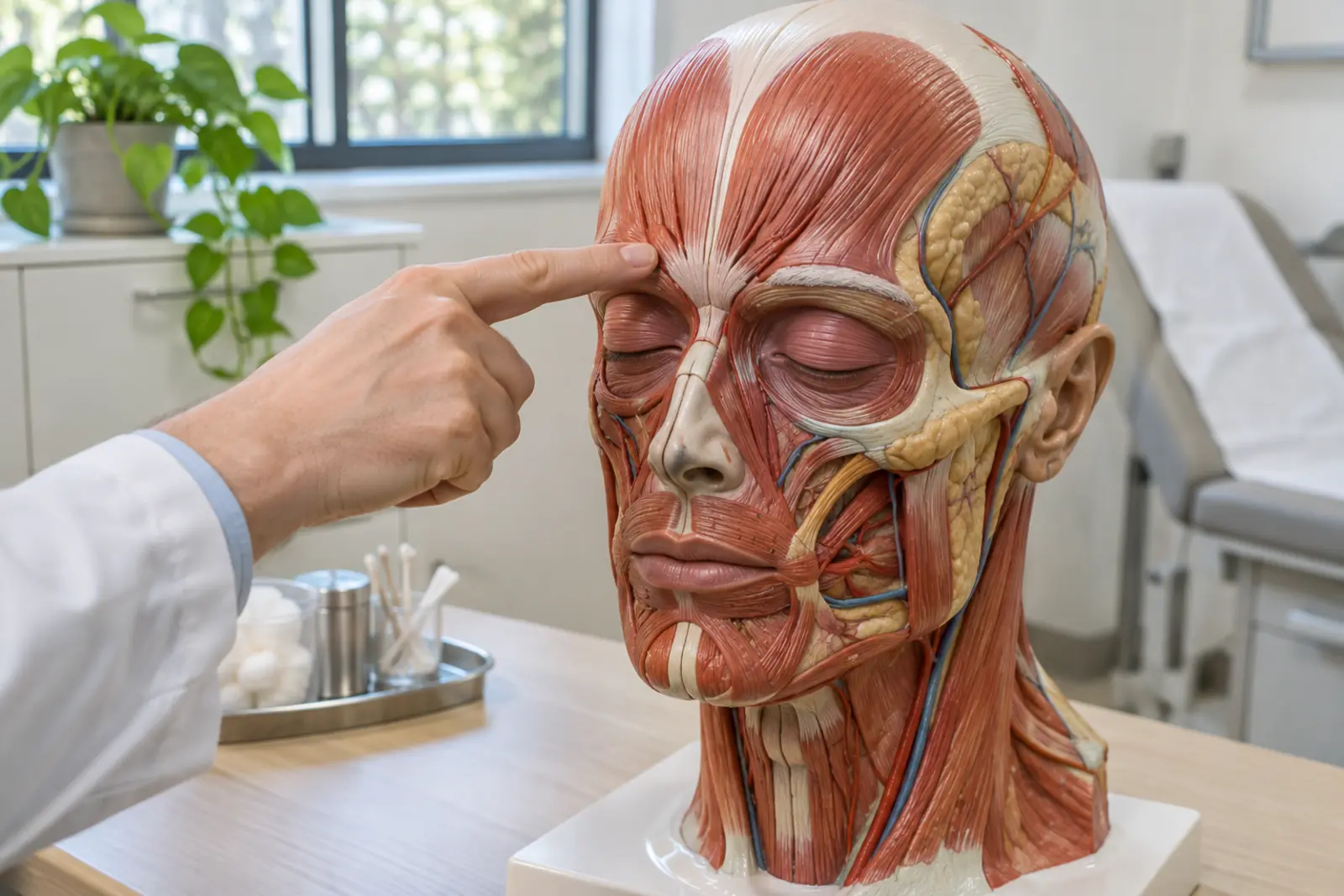
Brow ptosis is the drooping of the eyebrow, together with the brow fat pad beneath it, below the bony rim of the eye socket. The fallen brow adds weight to the upper eyelid and can give the face a permanently sad or angry look that has nothing to do with mood. It is a separate problem from eyelid ptosis, where the lid margin itself sits too low, and from dermatochalasis, where the lid skin is loose and redundant. The three often occur together, which is why brow position is checked before any eyelid operation is planned.
What brow ptosis is and what it does to the eyelid
Brow features and contour give a face its distinctive expressions, and a dropped brow can also look permanently surprised, not only sad or angry, with no link to mood.
When drooping occurs, the brow and the subcutaneous brow fat pad add weight and heaviness to the upper eyelids. In severe cases the brow sits all the way down on the eyelid. Hereditary features contribute as well, particularly where there is natural hooding of the lid folds. Drooping of the brow and brow fat pad below the orbital rim is called brow ptosis.
With age the change is rarely confined to the brow alone. A 2022 surgical review in Facial Plastic Surgery describes brow ptosis occurring together with sagging of the lateral temporo-orbital region and upper-lid hooding, and argues that these periorbital structures should be treated as a single anatomical unit. Hollowing of the temples is a related change covered in the guide to temporal hollowing.
Brow ptosis, eyelid ptosis and hooding: how they are told apart
All three conditions make the upper eyelid area look heavy, so they are easy to confuse. The differences are in what is actually low.
- Brow ptosis: the eyebrow and its fat pad have descended and press down on the lid from above.
- Eyelid ptosis (blepharoptosis): the upper lid margin itself sits too low, whatever the brow is doing. See the guide to the types of ptosis.
- Dermatochalasis: the eyelid skin is excessive and hangs over the lid margin or lashes, whatever the brow or lid position underneath.
The conditions can hide one another. In a Mayo Clinic study of photograph-based assessment, agreement between the photo-based and in-person assessment of blepharoptosis was 94% when the eyelid margin was visible but 66% when overhanging skin obscured it, and the authors note that coexisting dermatochalasis or brow ptosis may need special photographic technique or video to be diagnosed correctly (Wagner et al., Ophthalmic Plastic and Reconstructive Surgery, 2022).
Why the true brow position can be hidden
Two common effects disguise brow ptosis. First, heavy upper-lid skin often triggers overactivity of the forehead muscle (frontalis), which lifts the brows to clear the visual axis. Second, earlier neuromodulator treatment of the muscles that pull the brow down can falsely raise the brow. A 2018 paper in Aesthetic Surgery Journal by Sweis, Hwang and Cohen reports that, in their protocol, patients with earlier neuromodulator treatment of the brow depressors waited four months after the last treatment so that the true anatomic brow position could show before surgical planning. The role of toxin in this area is described in the guide to botulinum toxin.
Why brow position is assessed before eyelid surgery
Removing eyelid skin while ignoring a dropped brow can pull the brow lower still. Assessing brow position first is what determines whether a brow procedure should be done instead of, or alongside, a blepharoplasty.
In practice, a modest brow lift often allows a better eyelid result, because the surgeon can contour the lid skin and subcutaneous tissue properly once the weight from above has been addressed. A 2025 review in Otolaryngologic Clinics of North America lists the three things assessed when evaluating a patient for a brow lift: brow position, upper eyelid redundancy and the hairline. For how the decision between the two operations is made, see the guide to brow lift versus upper blepharoplasty; for how the lid operation itself works, see upper eyelid surgery.
Lifting without the surprised look
The brows can be raised without producing a startled appearance. The desired shape and position should be discussed before surgery, because the aesthetic target varies enormously between faces and between individual preferences.
Approaches range from a direct lift, in which the incision sits at the brow itself, to lateral and endoscopic techniques placed further back. Each has different trade-offs in scar position, degree of lift and how the lift is maintained over time.
Surgical options for brow ptosis
The 2025 Otolaryngologic Clinics review describes six main routes to a brow lift: coronal, pretrichial (hairline), endoscopic, temporal, direct and mid-forehead. Which one suits a patient depends on the brow position, the amount of lid skin and the hairline, and on the result wanted. Where the brow only needs light stabilization during an eyelid operation, a smaller step is sometimes enough; this is explained in the guide to browpexy through the blepharoplasty incision.
How much lift endoscopic surgery gives and how well it lasts
A 2025 systematic review and meta-analysis in Aesthetic Surgery Journal (Sibar et al.), pooling 12 studies of endoscopic brow lifts, found long-term elevation of about 3.25 mm at the medial brow, 3.86 mm at the center and 4.35 mm at the lateral brow. The values are averages, so they describe typical outcomes and not a guarantee for any one person.
Complications and fixation methods
A 2025 scoping review in Aesthetic Plastic Surgery (Caceres et al.) covered 27 papers and 2,519 patients across 11 fixation methods for endoscopic brow lifts. Neurological complications were the most common category at 11.69%, followed by aesthetic problems at 6.27%, other problems at 4.94% and wound-related problems at 1.19%. Bone-tunnel fixation had the lowest complication profile and screw fixation the highest, but the authors conclude that no single best approach can be named because studies report outcomes inconsistently.
Frequently Asked Questions
What is brow ptosis?
Brow ptosis is the descent of the eyebrow and its fat pad below the orbital rim. It adds weight to the upper eyelid and can create a sad or angry look. It is not the same as eyelid ptosis, which is a low lid margin.
What causes brow ptosis?
It is a feature of facial aging, often seen together with sagging of the lateral temple and orbit and hooding of the lid. Hereditary features play a part too, especially where the lid folds naturally hood.
Can eyelid surgery fix a dropped brow?
Not by itself. A standard blepharoplasty removes or reshapes lid skin and fat; it does not lift the brow, and removing lid skin without addressing a low brow can pull the brow lower. That is why brow position is assessed first, and why a brow procedure may be done instead of, or together with, the eyelid operation.
How much does a brow lift raise the brow?
It depends on the technique and the patient. For endoscopic brow lifts, a 2025 meta-analysis found long-term elevation averaging about 3 to 4 mm, slightly more at the outer brow than at the inner brow.
Can botulinum toxin hide brow ptosis?
Treatment of the muscles that pull the brow down can falsely raise the brow and make brow ptosis look milder than it is. For that reason one surgical protocol waits four months after the last treatment before assessing brow position. The page on botulinum toxin covers what the treatment does around the eyes.
Sources: Sibar et al., Aesthetic Surgery Journal, 2025; Caceres et al., Aesthetic Plastic Surgery, 2025; Minehart and Barrera, Otolaryngologic Clinics of North America, 2025.
General information only, not medical advice. Individual anatomy and healing vary. See the disclaimer.